Introduction to the network analysis tool „Gephi“

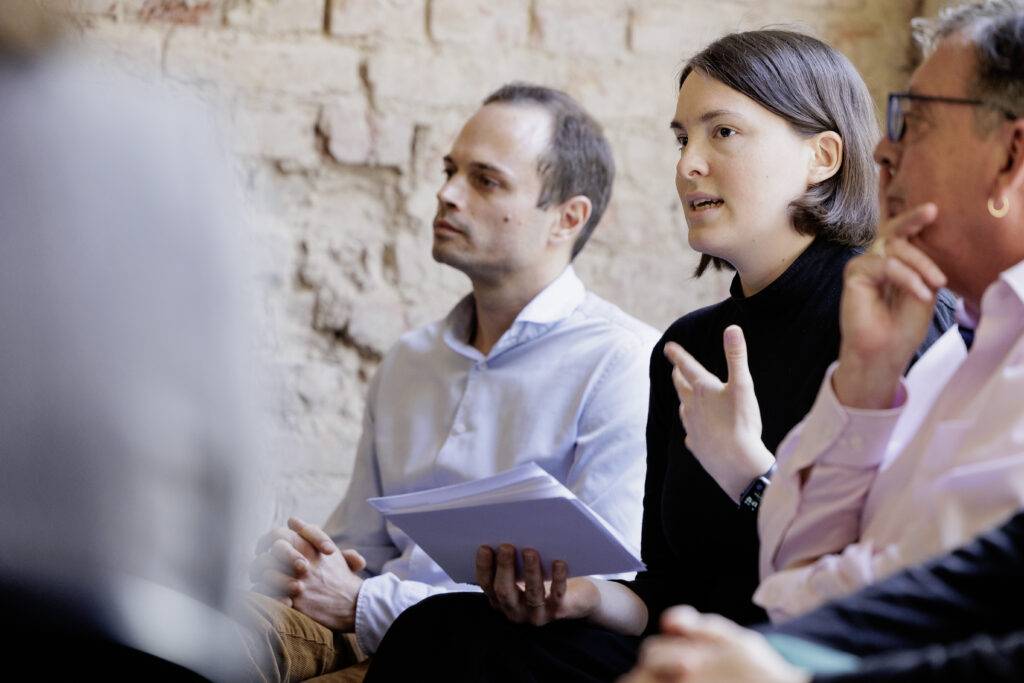
Which digital research tools can we use to enrich ethnographic methods? At the end of March, we held an introductory session on the network analysis tool Gephi, which was guided by this question. Gephi can be used to visualise tabular data sets as graphs. The programme is typically used to analyse large data sets, which are often collected automatically. In our workshop, together with Mace Ojala from Ruhr University Bochum, we considered whether and how Gephi can also be used effectively for qualitative research with ethnographic methods. Both students and researchers from the ‘Fixing Futures’ graduate college took part. A big advantage for everyone: the software is open source and therefore freely available.

The graph, Gephi’s central function, has the typical form of a network of nodes and connecting lines, known as ‘nodes’ and ‘edges’. Network semantics has become established in almost all areas of society over the last few decades: the metaphor of the network can be used to describe the relationships between discrete instances (e.g. individuals, organisations or objects). It thus offers a possible perspective on the world that has a long tradition in science and technology studies, for example in actor-network theory or in relational approaches. The research software Gephi was developed to enable the visual representation and computer-assisted analysis of networks on the basis of a database.

In our workshop, we first clarified some basic epistemological assumptions of network thinking in order to develop conditions for the meaningful use of Gephi and comparable tools for ethnographic research. These are characterised by the fact that they mostly examine practices and focus on the relationships and entanglements of their empirical objects. The metaphor of the network can help to recognise the connections between human and other entities in the field that arise through practice and in practice, to transfer them into a symmetrical scheme and thus make them accessible to scientific analysis. Guided by Mace Ojala, we were able to jointly explore this underlying logic of network analysis and consider which aspects of our various research projects we would like to digitally map in this way. We also discussed the difficulties of translating ethnographic material into the network logic of Gephi: observations from the field cannot always be transferred into the tabular form required for the creation of a graph. For example, the intensity or relevance of a contact can be visualised using numerical weightings or colour codes. However, many decisions must be made in advance, such as how intensity or relevance manifest themselves in the field and whether they can be quantified appropriately in all cases.

The introduction was therefore a good opportunity to look at the various STS research projects at Goethe University in Frankfurt with new methodological questions and to discuss the potential and obstacles of digital research tools. What we take away: Working with the Gephi software tool not only allows us to generate clear graphs, but also helps us become aware of our own scientific working methods and make implicit ethnographic assumptions explicit. A valuable practice for our projects!
Data Walk | NEW EDITION

On the Traces of Mobility Data: An Interactive Data Walk through Frankfurt

As part of the accompanying programme for the exhibition On the Move! Frankfurt and Mobility at the Frankfurt Historical Museum, we offered a public data walk in May. As this was very well received, we are repeating the offer again in autumn

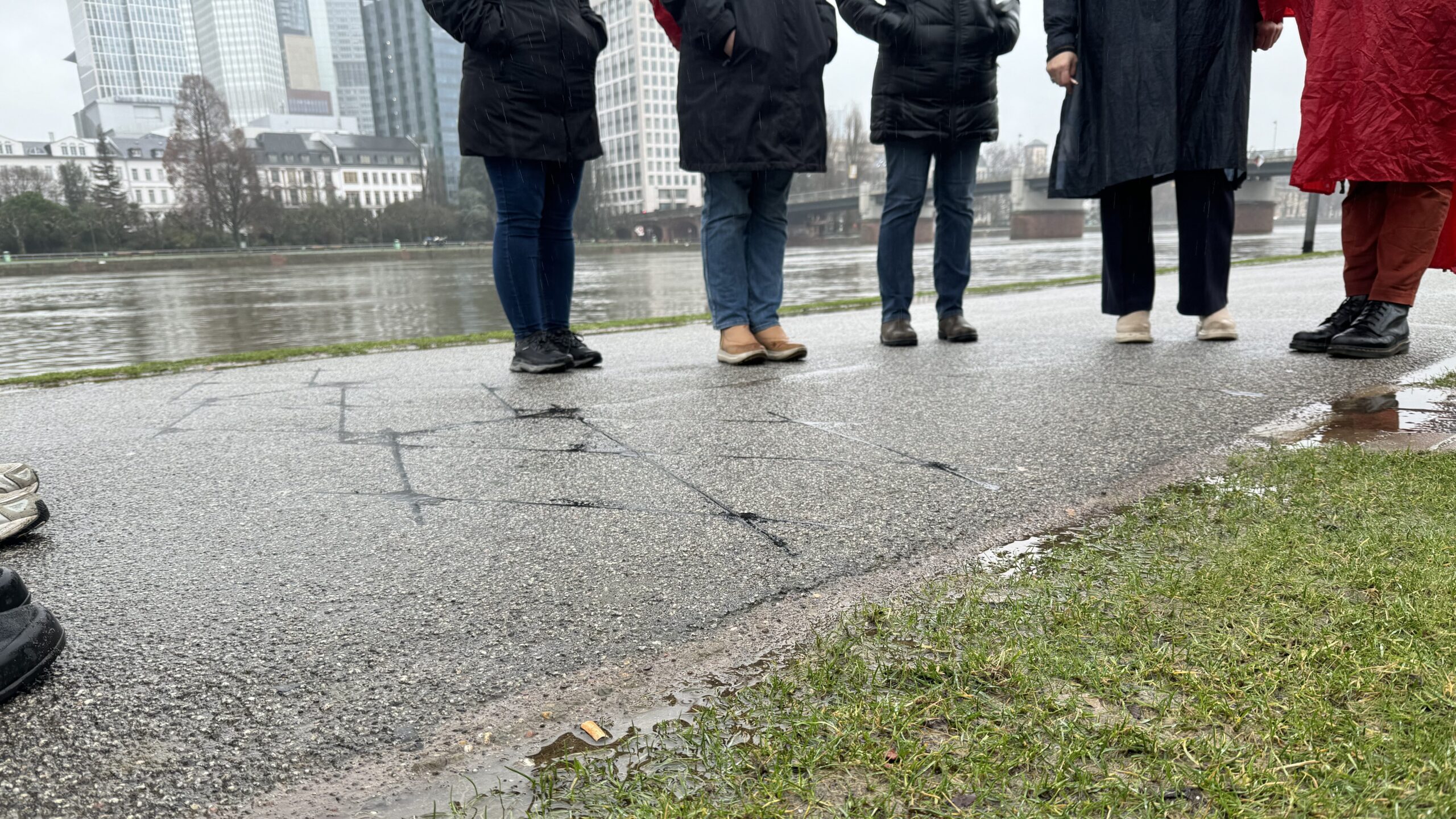
Gruppe steht neben einer im Boden verlegte Induktionsschleife

25.10.2025 | 15:00 Uhr

Led by: Catharina Dietrich, Janine Hagemeister (Institute for Cultural Anthropology and European Ethnology at Goethe University Frankfurt)

Registration: No prior registration is required.

Meeting point: We will meet at 3 p.m. in front of the main entrance of the Historical Museum (Saalhof 1, 60311 Frankfurt am Main).

Accessibility: The walk will cover a distance of approximately 3 km. Content will be presented both visually and verbally. However, we want to make the walk accessible to all participants. Please contact us in advance at datenpolitiken@uni-frankfurt.de so that we can take your needs into account and find a suitable solution together.

In case of bad weather: In the event of thunderstorms or heavy rain, we will meet in the foyer of the museum and hold a discussion there about the data landscape.

Description

Frankfurt is on the move – every day, hundreds of thousands of people travel around the city, along with goods and merchandise. As a designated ‘smart city’, Frankfurt is increasingly recording traffic volumes digitally: while data on car traffic is collected in real time, only isolated data patches exist for other modes of transport such as cycling and walking.

We would like to explore the city with you, following the trail of different mobility data.

Together, we will visit various measuring stations in public spaces. We will look at data available for specific locations and discuss our perceptions of street space and different perspectives on the city. In short presentations from our research project ‘Tracing Data Politics,’ we will talk about how digital traffic data is integrated into political contexts and recount the journeys that data takes from its creation to its use.

The event is open to the public and part of the programme of the Goethe University’s Citizens’ University

Workshop at the Ethnography Studio at USC 2024

In September 2024, as part of a research trip to Los Angeles, we organised the workshop „Missing, Underappreciated, Found“ together with Andrea Ballestero as part of the Ethnography Studio and discussed our research on the topic of „Maps and Models as Machine Ethnography“ with colleagues.

With the Ethnography Studio at the University of Southern California in Los Angeles, Andrea Ballestero and Katie Ulrich have created a forum that brings together ethnographers from various disciplines – from art and engineering to anthropology, computer science and sociology. Here, researchers experiment with new approaches to understanding complex social phenomena. A guiding principle is that the uncertainties and ambiguities of ethnographic research prove valuable for creative thinking. The studio embraces a diversity of methods and theoretical perspectives and values contradictions over coherence. Members develop their projects and research ideas in a collaborative space where they ask each other challenging questions.

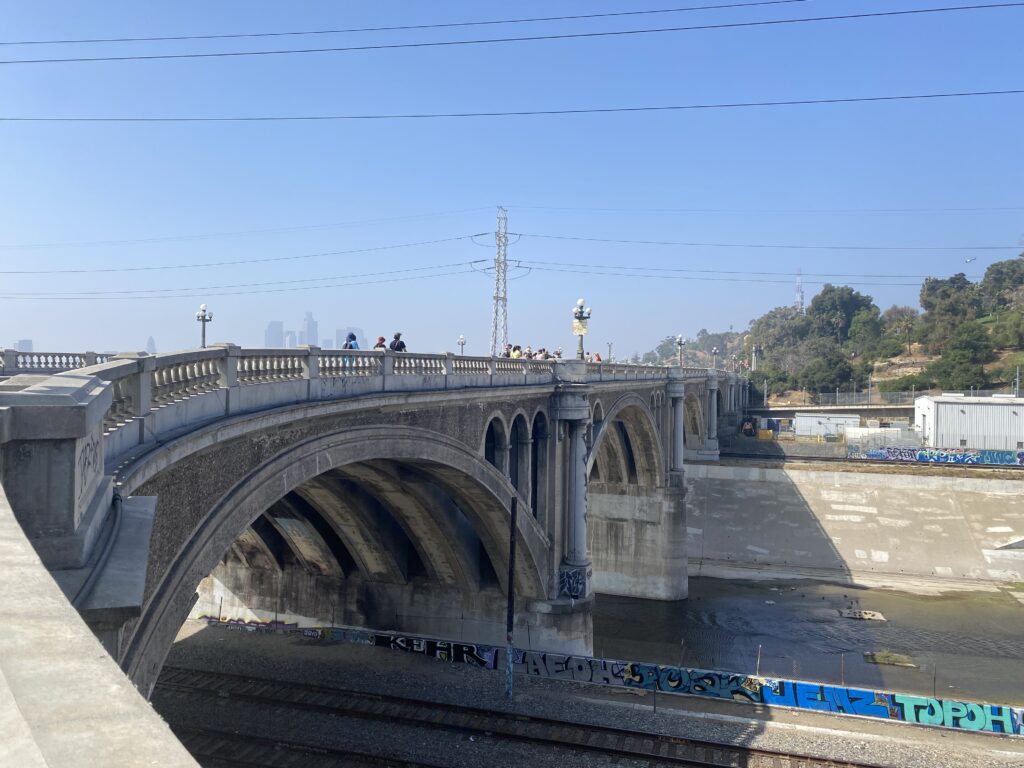
During a river tour on the second day of the workshop, we gained exciting insights into the more-than-human assemblages that make up the infrastructure of Los Angeles.

„Missing, Underappreciated, Found“

The workshop Missing, Underappreciated, Found” examined the transitional devices that ethnographers encounter or create themselves in their work to develop their research projects. The aim was to highlight the possibilities that these ethnographic tools (such as satellite maps, databases, quantitative models) open up when their use complements established ethnographic methods such as participant observation and interviews.

In addition to our project group, two other projects presented their ongoing research: Labyrinth (UCLA) and Expanding the Social World Downwards (USC).

Read more

In our own article, entitled Maps and Models as Machine Ethnography, we examined how digital mapping and quantitative models as tools and objects of ethnographic research enable exciting perspectives and insights. We compared two objects: the new traffic model being developed by engineers in the city of Frankfurt and our own experimental mapping of the complex landscape of actors and data in the context of the mobility transition in Frankfurt, which we created using the digital graph visualisation software Gephi. In doing so, we showed how these digital models and maps are not representations of reality, but rather, in their reduction of complex interrelationships, are themselves world-shaping and actively shape and expand ethnographic research and its questions.

How does knowledge get into motion? City talk: Mobility and participation in the city

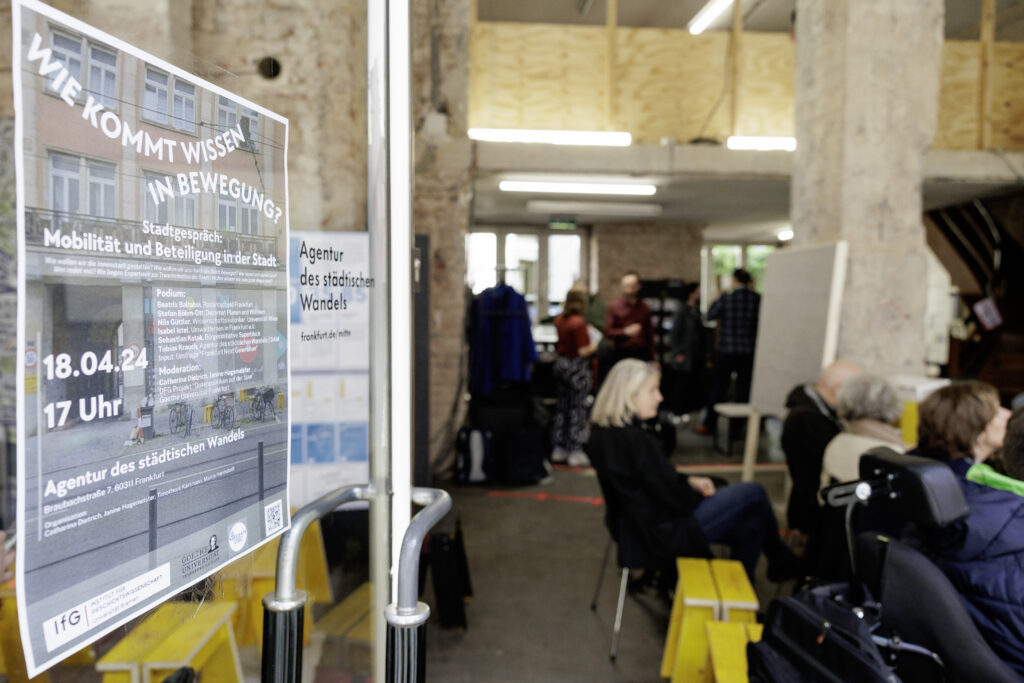
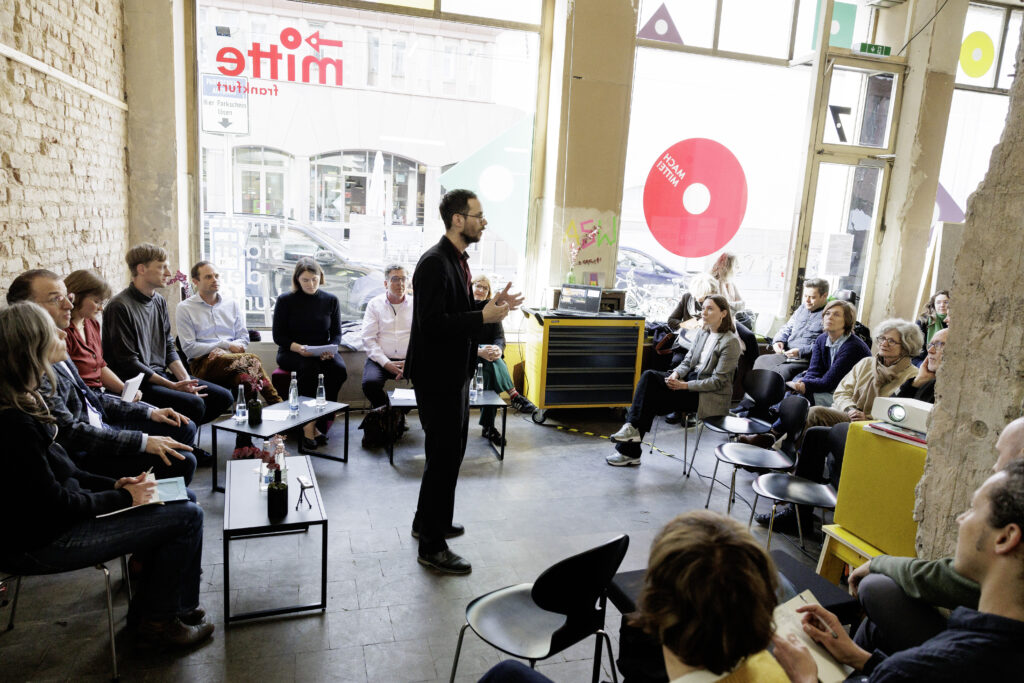
On 18 April 2024, the Agency for Urban Change (Agentur des Städtischen Wandels) opened its doors and invited the people of Frankfurt to a discussion on mobility and participation in the city. The headline was: ‘How does knowledge get moving?’ This free and public event was organised in close cooperation with several research projects and institutions.

© Stefanie Kößling

The organising team consisted of Martin Herrnstadt, head of the international research network “Global Cultures of Enquête: Towards a Praxeology of Surveying (17th – 21st Century)” at the Institute of History at the University of Bremen, Timotheus Kartmann with his research project “Das soziale Museum“ and Janine Hagemeister and Catharina Dietrich from the project „Tracing Data Politics“ . The aim was to bring together different positions and perspectives from experts in urban society, academia and administration and to initiate a dialogue between them.

© Stefanie Kößling

Johanna Lanio from the Polytechnic Society kicked things off with a short presentation of the ‘Frankfurt Next Generation’ survey. This survey was aimed at users of digital platforms and was designed as a low-threshold participation opportunity. We then moderated a panel discussion in which the invited experts reported on their experiences with participation processes and knowledge production in the context of urban development.

Isabel Istel from the Umweltlernen in Frankfurt e.V. association provided exciting insights into the participation projects with children and young people that were part of the process of creating the Mobility Master Plan. The projects, in which schools in Frankfurt were involved, met with great approval both on the panel and among the audience. Several voices from the audience emphasised that such formats should be offered more frequently in order to give young people the opportunity to actively shape their city. Tobias Krauch presented the participation projects of the German Architecture Museum and the Agency for Urban Change and explained how real-world laboratories are used to initiate participation in various urban spaces and to test new forms of dialogue.

Nils Güttler supplemented these practical experience reports with a scientific classification. As a science historian at the University of Vienna, his research focuses on „counter-knowledge“ and participation, among other topics, and in the panel discussion he linked the findings from his historical research with current issues. He drew parallels to the protests against the expansion of Frankfurt Airport in the 1980s, during which citizens produced their own knowledge to challenge hegemonic structures. At the same time, he pointed out that the framework conditions for participation and its political significance have changed since then. Today, the integration of knowledge from urban society is much more self-evident.

© Stefanie Kößling
© Stefanie Kößling

During the discussion, it became clear that participation brings not only opportunities but also challenges. Sebastian Kotek from the Superblock Initiative in Bockenheim and Beatrix Baltabol from Radentscheid talked about what voluntary work can achieve and what support initiatives need. Stephan Böhm-Ott from the Department of Planning and Housing was also present as a representative of the city and enriched the discussion with his views on the possibilities and impossibilities of urban planning.

Read more

Isabel Istel spoke about the difficulties that become particularly apparent when working with teenagers. She described how important it is for young people to experience democracy through participatory projects. However, she also addressed the frustration that arises when simple requests, such as the installation of a zebra crossing, take a long time to be implemented – often so long that by the time they are finally completed, the young people have long since changed schools. Several panel guests emphasised that participation projects should be made more visible in order to promote the exchange of different perspectives and achieve greater impact in the long term.

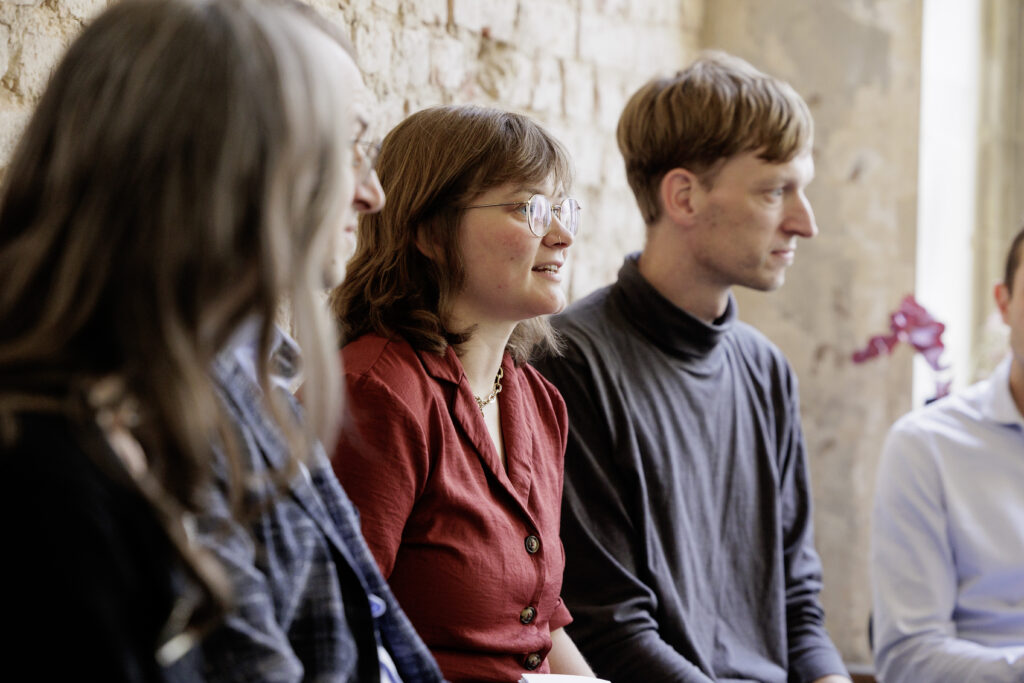
The vibrant audience discussion formed the centrepiece of the evening. Numerous visitors contributed their own experiences and enriched the debate with their perspectives. As the panel was not able to reflect the diversity of Frankfurt’s urban society, it was particularly important to us to give all voices plenty of space. We were delighted that a representative of the Frankfurter BehindertenArbeitsGemeinschaft (FBAG) was also present and used the public platform to voice his criticism of urban planning processes.

After the official part of the event, many guests stayed for a relaxed chat over drinks. In this relaxed atmosphere, numerous conversations developed and new contacts were made.

An exhibition was also set up in the room, visually presenting various aspects of the participation projects. Large posters showed the results of youth participation in the Mobility Master Plan and drafts of the Radentscheid initiative. The Superblock Bockenheim citizens’ initiative presented data that its members had collected in OpenStreetMap. This included maps of pavement widths and parking regulations, which had been meticulously recorded by the activists.

The evening was rich in insights and changes of perspective for us. The event not only brought together different actors, but also showed how much knowledge and commitment there is in urban society.