An important part of the research project is the exploration and further development of various methods for qualitative research on digital data. Here are some key methodological areas that shape our work.
Ethnographic research
The most important method for our research project is ethnography. Participant observation and discussions with people who work with data on a daily basis provide us with exciting insights. Interviews allow us to learn more about the perspectives of various actors. In volume 85 of
Kulturanthropolo-
Data walks

Data walks allow us to explore the city with a special focus on the contexts in which digital data is created and its spatial references. Through conscious perception and sometimes multimedia documentation of the environment, as well as direct exchange with those present, we gain new perspectives on infrastructure and its social integration.
Digital actor mapping
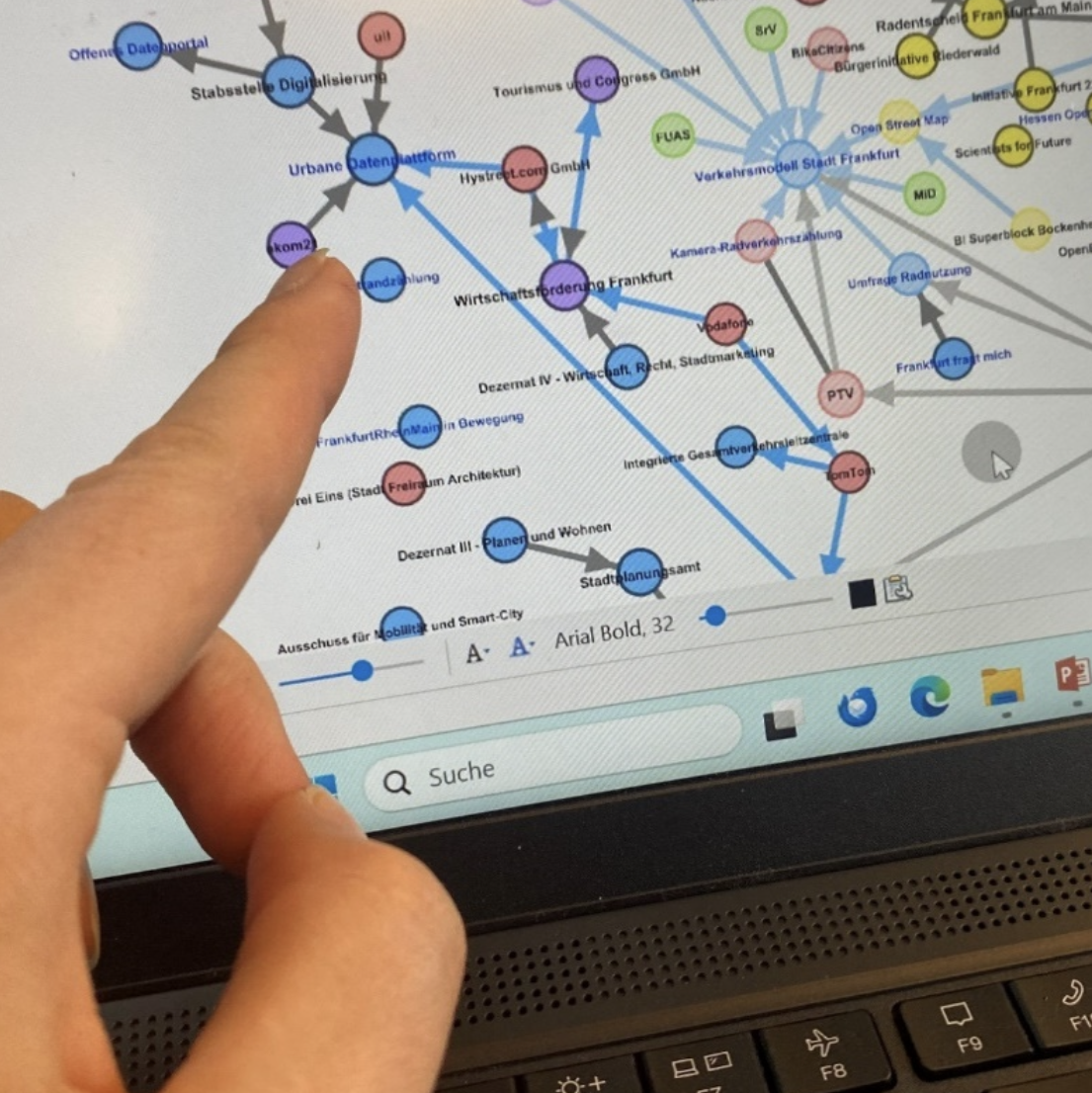
We use Gephi to visualise the complex interrelationships and data movements in the field of mobility transition policys. This digital mapping helps us to better understand the relationships between institutions, stakeholders and data platforms. Right from the start of our research, it was clear that a simple hand-drawn sketch would not suffice, as there are far too many actors and data sources involved. For us, software-supported network visualisation is a tool for analysis and offers a different approach to our ethnographic data. At the same time, mapping is also a process of reflection and a way of documenting our own research work.